Monday, April 21, 2008

spectrum of light


http://www.youtube.com/watch?v=5J8iEIQBlxc&feature=related

good

http://www.youtube.com/watch?v=bjOGNVH3D4Y&feature=related
with singing (funny)

Wow, your camera, webcam etc can see the light from your infrared remote control, good sci expt.


http://www.youtube.com/watch?v=biTb-ZEvREM

full spectrum from radio to gamma

http://www.youtube.com/watch?v=wKO5vfu8Gns&feature=related
no audio track to this one

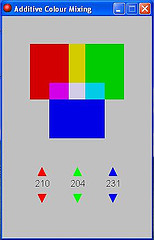
Colour mixing sim

source exe

Monday, April 7, 2008

Year 11 Physics - optics

Quite a few student videos of the experiment

Monday, March 24, 2008

Talking to an adolescent

Reflective Journal Entry 2: Talking to an adolescent

"The mind is not a vessel to be filled but a fire to be kindled." Plutarch (46 - 127)

"We cannot teach people anything; we can only help them discover it within themselves". - Galileo Galilei (1564-1642)

"It is not that students cannot learn, it is that they do not wish to" Mihaly Csikszentmihalyi, 1991

The following impressions were gained by interview of a 14 year old boy attending year 9 of a high fee private school.

The most striking thing that came from the interview is that kids want to learn, they are strongly motivated to learn. Primary motivating factors identified were being able to get a good job and meeting parents expectations. Other factors listed were having an interest in the subject and liking to compete with fellow students.

Learning how to behave appropriately in society was also listed as a major reason for schooling. Specifically, this meant learning how to get along with other people, including how to handle conflicts with peers, to know when to walk away from an argument.

Having the skills for a satisfying and meaningful life was also mentioned. “You need maths for most careers. But you can also use these skills at home, in hobbies for example” so education is also seen as preparing for a full and satisfying life.

There should be no surprise at this high motivation to learn. The desire to learn is an essential feature of all young mammals. Kids are pre-programmed to learn, it is called play.

"Games are thus the most ancient and time-honored vehicle for education. They are the original educational technology, the natural one, having received the seal of approval of natural selection. We don't see mother lions lecturing cubs at the chalkboard; we don't see senior lions writing their memoirs for posterity. In light of this, the question, "Can games have educational value?" becomes absurd. It is not games but schools that are the newfangled notion, the untested fad, the violator of tradition. Game-playing is a vital educational function for any creature capable of learning."
Crawford, The Art of Computer Game Design
http://www.vancouver.wsu.edu/fac/peabody/game-book/Coverpage.html


Kids thrive under an inspiring teacher and can work around an average teacher but a poor teacher can really kill learning.

What are the attributes of a good teacher? A bad teacher “has poor classroom control and you don’t learn anything”. A good teacher has a relaxed attitude in the classroom but can maintain control of the classroom. It’s actually the teachers who are uptight, insensitive or poor listeners that have poor classroom control. If the teacher can make the learning interesting, then classroom control is much easier. Then the learning happens. Kids want the learning to happen.

The teacher must teach to the whole class and be sensitive to their needs. For example, the teacher should share attention equitably between different ability groups.

Good teachers make learning interesting. They do funny stuff, they play along with kids, they have an instinct about to how to relate to the different ability levels in the class, they are inclusive.

How does this kind of teacher maintain their authority? I was unable to get a clear answer. A skilled teacher seems to know what the limits are when it comes to mucking around. I expect that a teacher has some natural authority, this is because kids want to learn and a good teacher can help them towards this goal.

Bad teachers “repeat everything a billion times”, they use needless repetition. Good teachers can present the same content but vary it by adding other elements and adding interesting side content. An example is the ball game. The teacher throw a ball and the student who catches it has to answer a question. “It works”. Another technique for learning vocabulary is to vary the task, one time they have to spell the word, next time they have to give the meaning.

What are the attributes of a bad teacher? “She was really mean to the kids did not listen to their needs. If a kid was crying, she would not listen to them and see why they were crying, she did not listen to what kids had to say, she would just yell at them, she had unrealistic expectations.”

What makes a good school principal? “Principals should listen to what students are saying about their teacher”. The kids can’t go to the principal and say “my teacher sucks”, so the principal must be a good listener and a good observer.

My final impression is that I could be a better listener. Listening to the tape, there are a few examples where I interrupted with a question and things might have developed nicely if I had said nothing.

Sunday, March 23, 2008

Making atomic physics fun

VCE year 11 physics unit 1, area of study 2 is Nuclear and Radioactivity Physics. The textbook is Heinemann Physics 11

http://msrb.wordpress.com/2007/09/12/hiroshima-peace-memorial/
The image files are licensed under Creative Commons Attribution ShareAlike 2.0 License (cc-by-sa-2.0)

The area of study is unfortunately didactic, which does not easily lead to higher order thinking and independent inquiry. The outcome is listed in terms of describe and apply, lower order skills on Bloom's Taxonomy. Only in assessing bias in the media and assesing risk do higher outcomes get mentioned.

Add teaching this to a group with a high proportion of English as a second language, though understanding the concepts may be easy, the language of instruction may be difficult.


A solution would be to lean heavily on visual and practical materials. Youtube has a a number of student created videos which give inspiration:

YouTube - Nuclear Physics in 3D ( good 3D modelling but does have some factual errors (I think) alpha particles not gamma and critical mass is more about amount of material than compression though compression needs to be maintained through fission
YouTube - Death Metal Physics[The cutlass head charity - atom] history of nuclear physics to a heavy metal sound track
YouTube - Nuclear Fusion, Fission, & Decay A fun and detailed explanation of the concepts, delivered with enthusiasm though the explanations may be unclear
YouTube - Nuclear Fission A 3D animation of nuclear fission made for an animation class using Maya and After Effects
YouTube - Fission (nuclear physics) simulate nuclear fission by running into each other on the sports ground

The mousetrap and pingpong demonstration
100 mousetraps
6000 mousetraps

more stuff

YouTube - Castle Bravo - What went wrong? Explaination
YouTube - Structure of the Atom 3: The Rutherford Model
YouTube - Nuclear Physics 8.1: Natural Transmutations
YouTube - Atom video
YouTube - physics atomic bomb nuclear test

the links in braces are temporarily? unavailable but you can get them in a zipfile if your school hasn't blocked this site
Open source {fission simulation} (requires GameMaker)
{Nuclear decay simulation standalone exe}

Applets from Physics 2000, University of Colorado Boulder
MIT open courseware lecture video and audio

Nanotechnology
When things get small University of California Television (thanks Karlie for links)
Cancer_killer_in_action
Cellular_visions_The_inner_life_of_a_cell

Girls and physics
Madam Curie video1 2 3 4

Tuesday, March 11, 2008

Blooms Taxonomy and an English test

Bloom's Revised Taxonomy

Remembering
Understanding
Applying
Analysing
Evaluating
Creating


Can be used to evaluate the Year 7 AIM2007 English test (to make sense you also need the Horizons resources)

Q1 understanding
Q2 understanding
Q3 analysing
Q4 analysing
q5 analysing
q6 understanding
Q7 remembering
Q8 remembering
Q9 understanding
Q10 understanding
Q11 evaluating
Q12 remembering
Q13 understanding
Q14 evaluating
Q15 evaluating
Q16 analysing
Q17 understanding
Q18 analysing
Q19 understanding
Q20 understanding
Q21 understanding
Q22 understanding
Q23 understanding
Q24 remembering
Q25 evaluating
Q26 evaluating
Q27 understanding
Q28 understanding
Q29 understanding
Q30 understanding
Q31 remembering
Q32 remembering
Q33 remembering
Q34 remembering
Q35 remembering
Q36 remembering
Q37 remembering
Q38 remembering
Q39 remembering
Q40 remembering
Q41 remembering
Q42 applying
Q43 applying
Q44 applying
Q45 evaluating
Q46 applying
Q47 applying
Q48 applying
Q49 applying
Q50 applying

My categorisation was a bit rough, done on the fly, but here are the results:
The 2 lower levels of Bloom's Taxonomy are well represented, the upper levels are poorly represented and the highest level, creating, is not tested.

What does this say of a test which claims to monitor state wide achievement?
  • the full suite of skills is not evaluated
  • schools are not given any credit for teaching higher order skills
  • students are given the message that higher order skills are not valued
  • there are insufficient questions to reliably evaluate middle order skillls
Fortunately there is also a writing test, with examiner instructions which I have not evaluated.

Thursday, March 6, 2008

Testing sunscreen, an activity for grade 8

Thanks to Adam, the idea was his. It is based on the fact that tonic water contains quinine which fluoresces under ultraviolet light.

Tonic water (L) and tap water (R) lit by an insect electrocuter

This is a learning activity for grade 8 kids. Its intended outcomes are:

  • Safe behaviour relating to sun exposure
  • ie. declarative knowledge about SunSmart behaviour which is applied in daily life
  • Declarative knowledge about sun exposure and health
  • Declarative knowledge about the spectrum and ultraviolet
  • Scientific method
  • Experimental design
  • Problem solving

http://commons.wikimedia.org/wiki/Image:Regenbogen_%28NASA%29.jpg

Requirements, tonic water, tap water, 2 glasses, glass plate, sunscreen : no screen, low SPF, SPF30+. Sunlight and incandescent light but MUCH better with a UV source like an insect killer.

This is a lesson based on guided discovery by the kids.

LESSON
Hi kids, what do you know about SunSmart ?
Prompt the kids as required, they should be able to quote the key messages:
  • Slip - Clothing
  • Slop - Sunscreen
  • Slap - Hats
  • Seek - Shade
  • Slide - Sunglasses
Why do you do this?
Prompt till you elicit that sun exposure can cause health effects including skin cancer.

What is it about sunlight that does this?
Question their understanding further and elicit or explain that UV rays are the reason and that they are part of the spectrum and "more purple than purple" and hence invisible.

Hey kids, we have this really neat way of testing for ultraviolet light, the quinine in tonic water glows blue under ultraviolet light. Pour a glass of tonic water and tapwater, under sunlight there is a faint blue colour.

How do we know that the ultraviolet is making the blue colour and its not just blue water?
Wait for suggestions...
Would a different light be a way to test?
If you are lucky they will suggest artificial light. Chose incandescent lighting, well away from windows. Not fluorescent lighting, it contains UV. The blue colour is absent or very faint. At this point the kids should be convinced that a characteristic of sunlight causes the blue colour.

If you are lucky you will have an insect electrocuter or other blacklight source.
Kids, can you suggest anothe light source? Move to UV source. Wow it is really amazing!

OK kids we have 3 samples of sunscreen we want to test, any suggestions?
Typically they will suggest dissolving the sunscreen in the water, if you have time, try it, we didn't. Then they will suggest smearing it on the glass. We had a glass plate which we hinted at its use by looking hopefully at it, the kids got the hint and designed the experiment.

Glass plate smeared with 3 unidentified products, the kids were able to correctly identify moisturiser, SPF15 and SPF30

Tuesday, March 4, 2008

Web 2.0 or the read/write web

Web 2.0 or the read/write web has a number of educational possibilities. Here are a few.

Google Earth
Great for giving kids a real understanding of geography. They love seeing their own house from space. See placespotting for a fun geography game based on Google Earth. Google Earth now allows star viewing. I have used Skyglobe (DOS program) for a number of years.
See a sneak preview of Microsoft's new WorldWide Telescope

Thanks Bill & Roland for extra astronomy links
http://www.rmit.edu.au/scienceweek/eratosthenes
http://galileoandeinstein.physics.virginia.edu/lectures/gkastr1.html
http://www.samtsai.com/p468 (scroll down for video)
http://www.techdo.com/images/largest-know-star.htm (slides)

Bureau of Meteorology
www.bom.gov.au
Great radar and satellite images. Note some schools have an online weather station, Westall Secondary College and Emerald Primary School

Blogs
· can be maintained by students and used to reflect on their learning
· can be maintained by the teacher for students
· can be used by teachers to share pedagogy

Student blog see the blogroll on the LHS of http://gamedesign11.wordpress.com/ Year 11 student blogs

Blog by year 3 teacher for his students

my blog,
my favorite edubloggers:
http://billkerr2.blogspot.com/
http://artichoke.typepad.com/artichoke
http://learninggames.wordpress.com/

Reflection and the Middle School Blogger: Do Blogs Support Reflective Practices?
“Research examined 12 randomly selected blogs from a population of 38 teacher-created, teaching-centered blogs to determine whether they were useful reflective devices for practicing middle school teachers. The amount and depth of reflective practice, as measured by a researcher-created rubric, was examined as well. Results indicated that all participants engaged in some level of reflective writing. However, the depth and level of reflection varied within and among the blogs. The results reported here are useful for framing future research on the efficacy of middle school teacher blogs.”

RSS feeds can be used to track new postings to your favourite blogs e.g.
Bloglines is a FREE online service for searching, subscribing, creating and sharing news feeds, blogs and rich web content.

Wikis
Kids love vandalising their school's Wikipedia entry. Is this good learning or just a teachable moment? Apart from Wikipedia (which Nature Magazine found to be almost as accurate as Encyclopedia Britannica ) you can create your own educational wiki. E.g. http://learningevolves.wikispaces.com/

Social bookmarking
Teachers are communicators. A teacher argues why we should share. Its always good to see who is bookmarking the stuff you see as important, see what else they bookmark. My bookmarks

Youtube
Kids will respond well to a relevant and authentic task. Publishing for the whole world makes it pretty real – authentic.
Guitar, 37 million views
History Legomation

There are also heaps of online lessons there
my stuff

Online games
A list of the educational benefits of playing World of Warcraft
The credibility you get with the kids when you say you are a level 52 Dwarf Priest is truly amazing.

Facebook and Myspace
Pretty much useless so far, but see above on credibility. Teachers can have their own Myspace or Facebook and be more in touch with what kids are doing.

Secondlife
Lag City unless you have a really fast connection. Largely wasted on recreating “talk and chalk” classrooms but has lots of potential as a creative space. See http://del.icio.us/tonyforster/secondlife (me: Australis Gondwana)

Flickr
Photosharing http://www.flickr.com


Finally
A series of videos explaining things like RSS , blogs and social bookmaking in Plain English